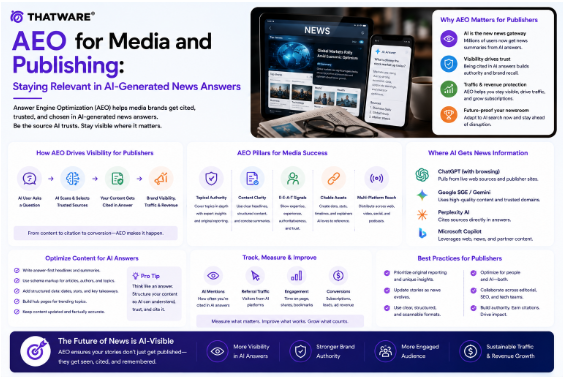
Media companies have a particular reason to pay attention to Answer Engine Optimization that goes beyond the usual brand visibility argument. For publishers, AI-generated answers aren’t just a new channel that might affect how people find them — they’re a direct competitive threat to the core product.
When an AI assistant answers a question that a reader would previously have searched for and found through a news article, that’s a substitution effect. The reader got the information they needed. The publisher got nothing — no pageview, no ad impression, no subscription consideration. The AI provided the value and kept the user.
That’s a structural challenge that the media industry is just beginning to grapple with seriously. But within that challenge, there’s also an AEO opportunity that forward-thinking publishers are starting to recognize.
The Citation Opportunity in AI Answers
AI systems that produce factual answers typically draw on sources — and the most credible sources, the ones that get cited most frequently, tend to be well-known media outlets and publications with strong reputations for accuracy and authority. If your publication is one of those sources, AI-generated answers can actually be a distribution channel rather than purely a competitive threat.
When an AI says “According to [Your Publication]…” or “A recent report from [Your Publication] found that…” — that’s brand exposure. It may not drive a click in that moment, but it builds the kind of ambient brand credibility that influences subscription decisions, direct navigation, and the general sense that your outlet is where important information comes from.
Building this kind of AI citation presence requires treating AEO as a strategic priority — not just hoping that high-quality journalism gets surfaced automatically. The publications that are most consistently cited in AI answers tend to have strong entity signals, well-structured content, and a history of being referenced by other credible sources.
Aligning with best AEO agencies for B2B / SaaS / eCommerce that have worked with media brands means finding partners who understand the specific mechanics of editorial credibility and how it translates (or doesn’t) into AI citation authority. The overlap between traditional media authority and AI answer authority is real but imperfect.
Structured Journalism and Machine Readability
Here’s a specific challenge for media companies. Traditional journalism is written for human comprehension — narrative structure, inverted pyramid, contextual development. This writing style is often not optimal for AI extraction. AI systems favor direct, clear, answer-first content. Long narrative context before the key fact, or implicit rather than explicit conclusions, can mean that even excellent journalism doesn’t get surfaced well in AI answers.
This creates a genuine editorial tension. Should journalism be written differently to accommodate AI extraction? Is that a compromise of craft, or an evolution of it? There’s no clean answer. But there are practical approaches — structured summaries, FAQ sections, explicit answer paragraphs — that can improve AI extractability without fundamentally changing the editorial character of the content.
Some publishers are experimenting with “AI-optimized summaries” that accompany longer-form journalism — short, structured versions of the key findings designed specifically for AI extraction. This hybrid approach lets the full journalism remain as written while providing AI systems an easily-accessible version of the key information.
Brand Authority vs Individual Article Authority
One nuance that matters for media companies: in AEO terms, there’s a difference between the authority of your publication as an entity and the authority of any specific article. Both matter, but they work differently.
Publication entity authority — the AI system’s overall assessment of your outlet as a credible source — affects whether your content gets cited generally. Individual article authority — the specific credibility signals around a particular piece of content — affects whether that specific content gets drawn on for specific queries.
A publication with high overall entity authority but individual articles that aren’t well-structured for AI extraction will get cited for general references (“as reported by…”) but may not have specific articles surface in direct answer queries. Building both levels of AEO authority — entity-level and content-level — is the comprehensive approach.
Subscriptions and AI: The Longer Game
For subscription media, the AI answer challenge has a specific angle that pure advertising-model publishers don’t face in the same way. AI-generated answers may reduce the search-driven traffic that leads to subscription conversions — but they may also increase the perceived authority and brand awareness that drives direct subscription consideration.
The AI answer engine optimization agency argument for subscription media is partly about the direct channel effects — AI mentions that drive traffic — and partly about the longer brand-building effect of being consistently cited as a credible source in AI answers about your coverage areas.
Readers who repeatedly encounter your publication’s name in AI answers — as a trusted source, as a reference, as the outlet that apparently broke this story or provided this analysis — are more likely to consider subscribing. The AI answer landscape is, in part, a reputation-building environment. And for media brands, reputation is the product.
The publishers that take AEO seriously in 2025 and 2026 are making a long-term bet that AI citation authority will translate into sustained relevance in a landscape that would otherwise erode their position. It’s a reasonable bet — and probably the right one.
